I used to think that the only way to scale a Shopify store was to dump more money into Meta Ads. I spent eighteen months obsessed with top-of-funnel metrics and lower CPCs, believing that volume would fix every other problem in the business.
I was wrong. Pushing more traffic into a leaky bucket just makes the floor wet and your bank account empty.
You do not need more traffic to grow next quarter. Most brands generating fifty thousand a month are sitting on a goldmine of existing customers who would buy again if the friction weren’t so high.
The expensive lie of the acquisition treadmill
Nobody tells you that your Customer Acquisition Cost (CAC) is probably higher than your actual profit on a first-time order. If you spend forty dollars to acquire a customer who spends sixty, and your COGS are thirty, you are losing money every time the pixel fires. The profit only happens on the second, third, or fourth order.
Standard e-commerce advice says to optimize your landing page or test new creative. That is fine for getting the first click. But the real margin lives in the customers you already paid for last month. The industry average for repeat purchase rates hovers around 20% to 30%, yet the top 10% of brands are hitting 50% or higher.
The difference between a struggling brand and a dominant one is the 90-day LTV. If you can move your 90-day revenue per user from $70 to $110 without spending another dime on Mark Zuckerberg, you win. This shift changes how much you can afford to bid, which eventually starves your competitors of traffic.
Stop treating mobile web like a destination
Here is a hard truth: your mobile website is a bridge, not a home. Most merchants look at their Shopify dashboard and see 80% of traffic coming from mobile devices. They see a 1.5% conversion rate and think it is just the nature of the beast. It isn’t.
Mobile web browsers like Safari and Chrome are designed for search, not for shopping. Every time a customer has to re-enter their email, find their credit card, or deal with a glitchy sticky header, you lose a sale. The friction on mobile web is the primary reason your repeat purchase rate is lower than it should be.
Think about how you shop on your own phone. You likely use the Amazon app or the Target app because it stays logged in and remembers your preferences. You do not go to their website. If you want your customers to treat you like a brand they love, you have to stop forcing them through a browser experience that feels like work.
The most expensive click is the one you have to pay for twice.
The mechanics of the 90-day retention loop
If you want to increase repeat purchases this week, you need to map out the journey immediately after the first box arrives. Most brands send a generic “Thanks for your order” email and then disappear until the next sitewide sale. This is a massive waste of momentum.
The first fourteen days after delivery are the highest intent period. This is when the customer is actually using the product and forming an opinion. Instead of a sales pitch, send them a utility-focused message. If you sell skincare, send a video on how to apply the serum. If you sell home decor, show them how to style the piece.
The goal is to move the conversation away from the noisy inbox. Email open rates are cratering, often sitting below 20% for promotional content. SMS is better but expensive, costing several cents per message. This is where a native app changes the math. You can send unlimited push notifications for free, keeping your brand top-of-mind without eating your margins.
Breaking down the communication channels
You need to understand where your messages actually land. A customer who sees your brand three times in a week is five times more likely to buy again than someone who sees it once. But frequency without cost-efficiency is a recipe for a high overhead.
ChannelTypical Open RateCost Per MessageFriction LevelEmail15-22%Very LowHigh (Spam filters)SMS90%+High ($0.01 – $0.05)Moderate (Intrusive)Native Push45-60%Zero / FixedLow (Direct to screen)
Why your checkout process is killing loyalty
Checkout friction is the number one reason people do not come back for a second purchase. If I have to walk across the room to get my wallet because your mobile site logged me out, I am probably going to close the tab. You just lost a hundred-dollar LTV because of a session timeout.
Native apps solve this by keeping the user authenticated. FaceID and TouchID allow for a two-tap checkout. When shopping is that easy, it becomes a habit rather than a chore. This is why brands like Lenskart or even small boutique fashion labels see a 3x higher conversion rate on their apps compared to their mobile sites.
Look at your analytics for the last thirty days. Compare your mobile conversion rate to your desktop conversion rate. If the gap is larger than 20%, you have a technical friction problem, not a product problem. Your customers want to buy; your website is just making it hard for them.
The specific steps to run this week
You do not need a massive team to start fixing your retention. Start by auditing your current post-purchase flow. Most Shopify owners set up their Klaviyo flows once and never look at them again. They are usually filled with generic templates that look like everyone else’s.
Follow this sequence to see an immediate bump in repeat intent:
-
Identify your top 10% of customers by lifetime value and send them a personal plain-text email.
-
Check your mobile site speed on a real device, not just a desktop simulator.
-
Implement a specific “Win-back” flow that triggers at 45 days if no second purchase has occurred.
-
Review your mobile navigation. Can a user find their previous order and re-order in under four clicks?
-
Stop spending 100% of your creative budget on new customer acquisition and spend 10% on “Thank you” content.
I recently spoke with a founder doing $80k a month who realized their mobile search bar was hidden behind a broken hamburger menu on 40% of Android devices. They were literally blocking their customers from giving them money. These are the details that matter more than your ad copy.
Stop renting your audience from Meta
Every time you run a retargeting ad, you are paying Meta for access to people who already know you. It is the equivalent of paying a landlord for a house you already bought. It makes no sense for your long-term profitability.
The goal of every e-commerce brand should be to own their distribution. Once a customer downloads your app or joins an exclusive community, you no longer have to pay to talk to them. You can announce a new drop or a flash sale and see revenue hit the dashboard instantly without the CPMs spiking because it is a holiday weekend.
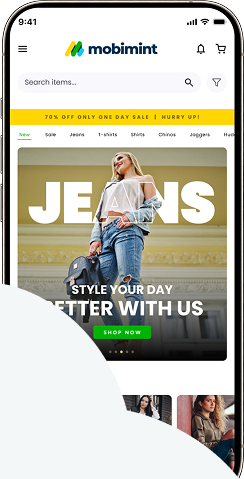
Mobimint was built specifically to handle this transition for stores that are tired of the subscription fatigue of other app builders. But whether you use a tool like ours or build something custom, the principle remains: the brands that survive the next two years will be the ones that stop relying on cold traffic and start focusing on their existing base.
Takeaway
Profitability is not found in the next big ad hack; it is found in the pockets of friction you remove from your mobile shopping experience. If you make it easier for your customers to return, they will. Go to your store on your own phone right now, try to buy your best-selling product while standing in line for coffee, and see how long it takes you.
Check your mobile bounce rate in Google Analytics specifically for returning users; if it is above 40%, you are losing money on every repeat visit.